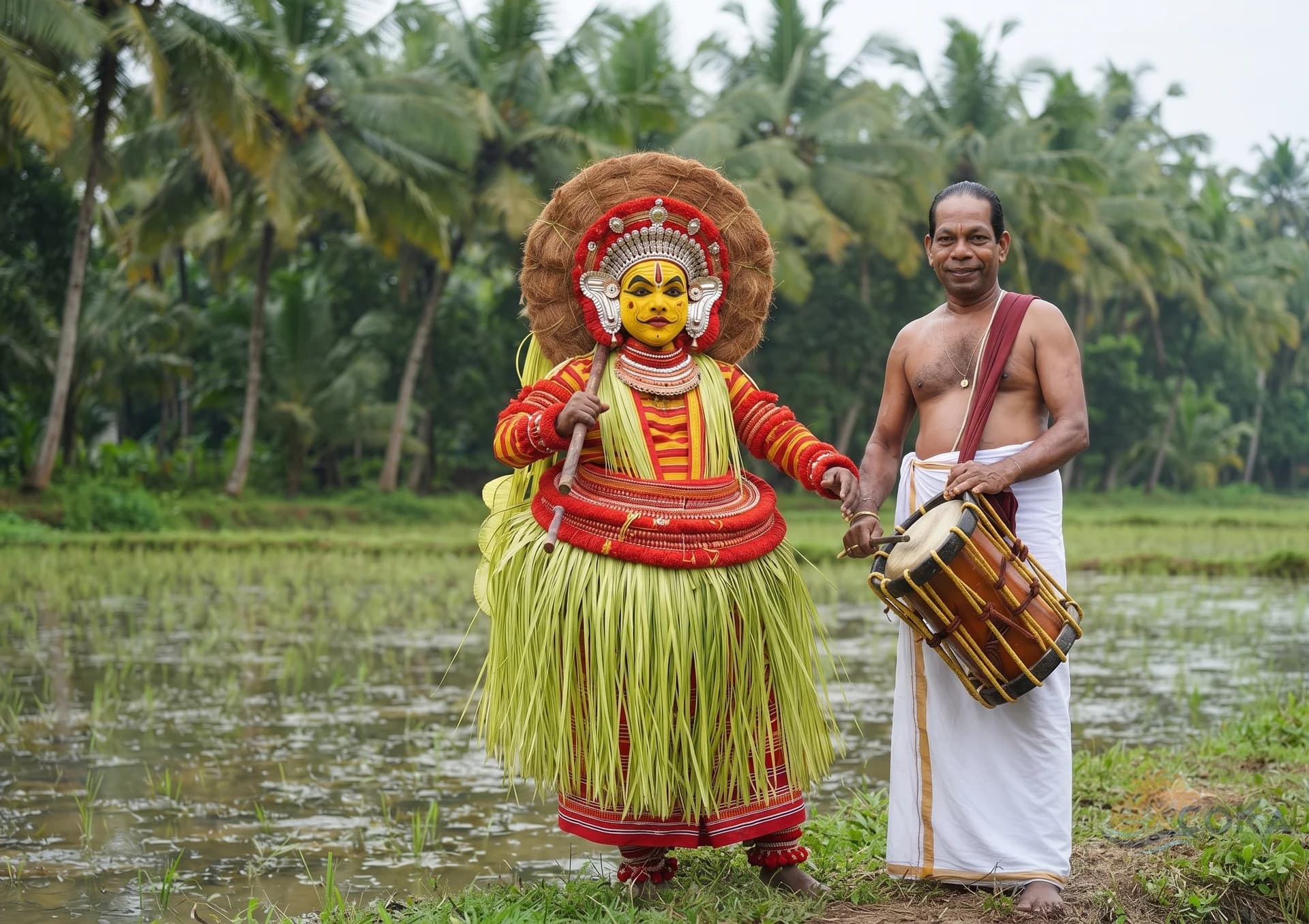
In Tulu Nadu, Aati is not just another month on the calendar.
It is the heart of the monsoon. The rain comes down heavily, the fields stay wet, rivers and streams fill up, and everyday life slows down. Traditionally, this was also one of the most difficult times of the year for farming families. The previous harvest was running low, while the next one was still some way away.
And then, during this month of rain and uncertainty, Kalenja would appear.
A man dressed in coconut leaves and natural materials, his face covered by a traditional mask, would walk from house to house. The sound of anklets and drums would announce his arrival. He would dance in front of the house while the family watched, and in return, they would offer rice, coconuts or other small gifts.
This traditional ritual is known as Aati Kalenja.
For someone seeing it for the first time, the sight can be fascinating. But for the communities that have carried the tradition for generations, Kalenja is much more than a colourful performance. It is connected to their old beliefs about protection, prosperity, nature and the coming agricultural season.
Why Does Kalenja Come During Aati?
To understand Kalenja, it helps to understand Aati itself.
Before modern transport, markets and year-round food supplies changed rural life, Aati could be a difficult period for farming communities. Heavy rain made agricultural work harder, and families depended largely on what was left from the previous harvest.
It was a time when people were especially conscious of disease, food shortages and the uncertainties of nature.
This is where Kalenja comes in.
According to local traditions, Kalenja is associated with a protective spirit that visits villages during Aati. In some traditions, the figure is connected with Kalanjapoothi, although the stories and interpretations can differ between communities.
The arrival of Kalenja is traditionally believed to drive away misfortune and protect households from illness and other troubles.
It is also connected with hopes for prosperity and a good agricultural season ahead.
In simple terms, Kalenja represents a community asking for protection during one of the hardest parts of the year.
What Does Aati Kalenja Look Like?
The first thing you notice is the costume.
The performer is covered almost completely with leaves and other natural materials, particularly coconut leaves and areca palm fronds. A traditional mask is often used to cover the face, giving the performer a striking and almost otherworldly appearance.
Ankle bells add to the effect.
Before you even see Kalenja, you may hear the bells and drums approaching.
The performer then dances in front of the house, accompanied by traditional rhythms and, depending on the local practice, folk songs.
Families gather around to watch. They may offer rice, coconuts, vegetables or a small amount of money.
The offerings themselves are simple. Their meaning is much bigger.
They are part of an exchange between the household and the ritual, with the family seeking blessings and protection in return.
More Than a Performance
It is easy for someone from outside the region to look at Kalenja and see a folk dance or cultural performance.
But traditionally, that isn't how the people taking part see it.
The performer is not simply entertaining the family. For the duration of the ritual, he represents Kalenja, and his visit carries religious and cultural meaning.
That distinction matters.
There are songs, music, costumes and dancing, but underneath all of that is an old belief that nature, spirits, agriculture and human life are closely connected.
That worldview is something you can find throughout the traditional culture of Tulu Nadu.
The Sound of Kalenja
The visual side of Kalenja gets most of the attention, but the sound is just as important.
The rhythm of the drums, the movement of the performer and the sound of the ankle bells create an atmosphere that is difficult to recreate on a stage.
In some villages, traditional songs accompany the ritual. These songs and chants can invoke local deities and express hopes for protection, good health and a successful harvest.
There is also something very personal about the way Kalenja moves from one house to another.
There isn't a huge stage or a distant audience.
The performance happens right at the doorstep.
The family watches from a few feet away, makes its offering and becomes part of the ritual.
A Tradition Passed Down Through Generations
Like many traditional practices, Aati Kalenja has had to deal with a changing world.
Agriculture is no longer at the centre of everyday life for many families. Younger generations increasingly move to cities for education and work. Traditional performers and the knowledge they carry are also becoming fewer in some places.
That creates a real challenge.
A ritual isn't just a costume and a dance. It includes the songs, the stories, the way the costume is prepared, the people who know how to perform it and the community that understands its meaning.
If those pieces disappear, the tradition can become difficult to keep alive.
Thankfully, Aati Kalenja continues to be practised in parts of Dakshina Kannada and Udupi, and cultural organisations and local communities have shown increasing interest in documenting and preserving traditions like this.
Why Aati Kalenja Still Matters
Aati Kalenja may look unusual to someone encountering it for the first time.
A masked figure covered in leaves walking through a rain-soaked village is certainly not something you see every day.
But that is also what makes it special.
Behind the costume is a story about how people once lived with the uncertainty of the monsoon. Behind the dance is a prayer for protection. Behind the offerings is the idea that a community should share what it has, even during difficult times.
And behind the entire ritual is a deep connection between people, agriculture and nature.
That is perhaps what makes Aati Kalenja worth remembering.
It isn't simply an old ritual that survived into the present.
It is a small window into how people in Tulu Nadu understood the world around them, especially during the long, difficult days of Aati.
When the rain falls, the drums begin and Kalenja arrives at the doorstep, an old tradition briefly becomes part of everyday village life again.