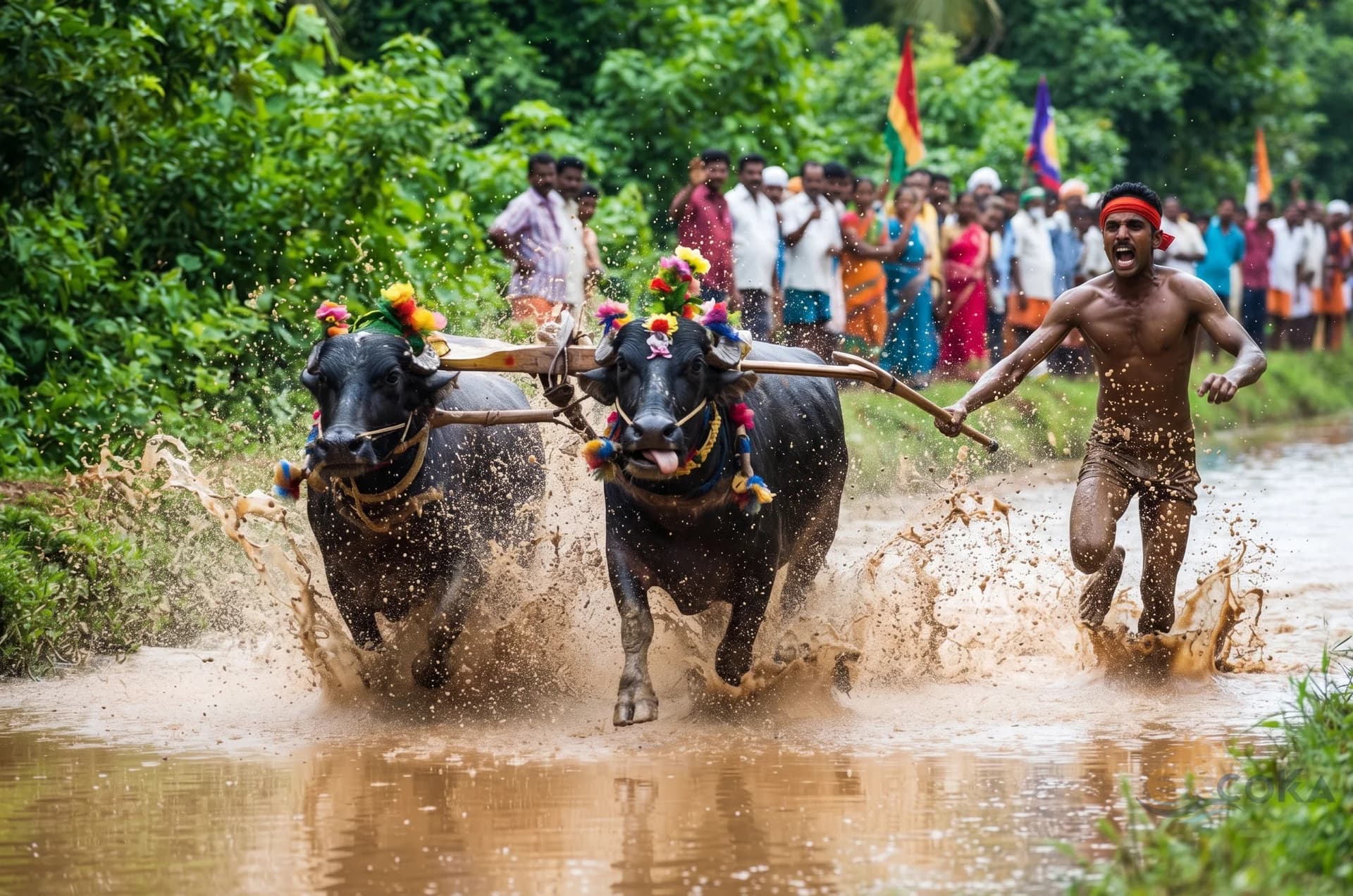
There is a certain feeling when Kambala season arrives in coastal Karnataka. The paddy fields are filled with water and mud, drums start beating, people gather along the track, and before long, two buffaloes come charging through the field at full speed.
For someone seeing Kambala for the first time, it can be difficult to take everything in. There is mud everywhere, people cheering, jockeys pushing their buffaloes forward, and an atmosphere that feels more like a village festival than a sporting event.
For the people of Tulu Nadu, however, Kambala is much more than a race. It is a tradition closely connected to farming, village life and the cultural identity of coastal Karnataka.
Kambala is generally held between November and March, after the harvest season. The fields that have just produced a crop become the setting for one of the region's most distinctive traditions.
Where Did Kambala Come From?
The exact origins of Kambala are difficult to trace. Like many old traditions, its history has been passed down through generations rather than recorded in one definite account.
Kambala is traditionally associated with agriculture and thanksgiving. After the harvest, farmers would celebrate and offer thanks to the local deities for a good crop and for the well-being of their cattle.
Buffaloes were an important part of farming life, particularly for working in the wet paddy fields. Over time, the celebration around the harvest developed into a competition involving the animals.
What may have started as a farming tradition gradually became a major village event, bringing together farmers, families and entire communities.
That connection with agriculture is still an important part of what makes Kambala special.
How Does a Kambala Race Work?
The Kambala track is usually a long stretch of paddy field filled with water and thick mud.
Two buffaloes are paired together and guided along the track by a jockey. The jockey stands on a wooden plank, traditionally known as a neg, which moves through the muddy water as the buffaloes run.
It looks simple from a distance. It isn't.
The jockey has to maintain his balance, control the buffaloes and encourage them to run at speed, all while moving through a slippery and uneven track.
The buffaloes also need to be trained and handled carefully. A successful pair depends not only on speed but also on coordination between the animals and the jockey.
And then there is the mud.
When the buffaloes hit the water at full speed, the result is an enormous splash that can send muddy water flying several metres into the air. For the crowd standing along the track, that is part of the fun.
Different Forms of Kambala
Kambala is not exactly the same everywhere. Different villages and regions have followed their own traditions and formats over the years.
One form is Kane Kambala, which has a more ceremonial and religious character. It is closely associated with village traditions and rituals rather than simply being a competitive race.
Then there is the more competitive form, commonly known as Baliye Kambala, where buffalo pairs compete against each other and performance becomes the focus.
The rules and categories can vary between events, and some Kambala competitions have their own local customs.
This is one reason why attending different Kambala events can feel slightly different each time. The tradition is shared, but every village adds its own character to it.
When Kambala Became a National Talking Point
For generations, Kambala remained largely a regional tradition. That changed when videos of Kambala jockeys and their remarkable race timings began spreading across India.
Some performances attracted comparisons with professional sprinting speeds, bringing national attention to the sport and its participants.
The discussion raised an interesting question: could Kambala identify athletes with the potential to compete in other forms of sport?
Whether those comparisons are completely fair is another matter, because Kambala and athletics are very different disciplines. But there is no denying that the speed, balance and physical control required from a Kambala jockey are impressive.
For many people outside coastal Karnataka, it was their first real introduction to Kambala.
Tradition, Animal Welfare and Change
Kambala has also faced criticism, particularly around animal welfare.
Animal rights organisations have raised concerns about the treatment of buffaloes and the methods used during training and competition. These concerns have led to considerable debate about how the tradition should continue in the modern era.
Kambala organisers and supporters have, in turn, argued for regulated events and better standards of animal care.
The larger question is not simply whether Kambala should continue. It is how an old cultural tradition can continue while meeting modern expectations around animal welfare.
That conversation is still evolving, and it is an important part of Kambala's story today.
Why Kambala Still Matters
The easiest way to understand Kambala is probably to stand beside a track during an actual event.
You will see farmers, children, elders, families and visitors gathered together. Some people come to support a particular buffalo pair. Others come because their village is hosting the event. Many simply come because Kambala is part of their culture.
Children watch from their parents' shoulders. The crowd erupts when a pair makes a particularly fast run. Drums keep the energy going, and the entire field seems to come alive for those few seconds when the buffaloes charge through the water.
The stopwatch matters, but it isn't the whole story.
Kambala carries memories of farming, village life, family and community. It connects today's generation with a tradition that has been passed down for generations.
That is why Kambala remains such an important part of Tulu Nadu.
It is muddy. It is loud. It is competitive. It has evolved with the times, and it continues to face questions about how tradition and modern standards can coexist.
But when those buffaloes charge through the flooded paddy field and the crowd rises to its feet, you can understand why Kambala continues to hold such a powerful place in the culture of coastal Karnataka.