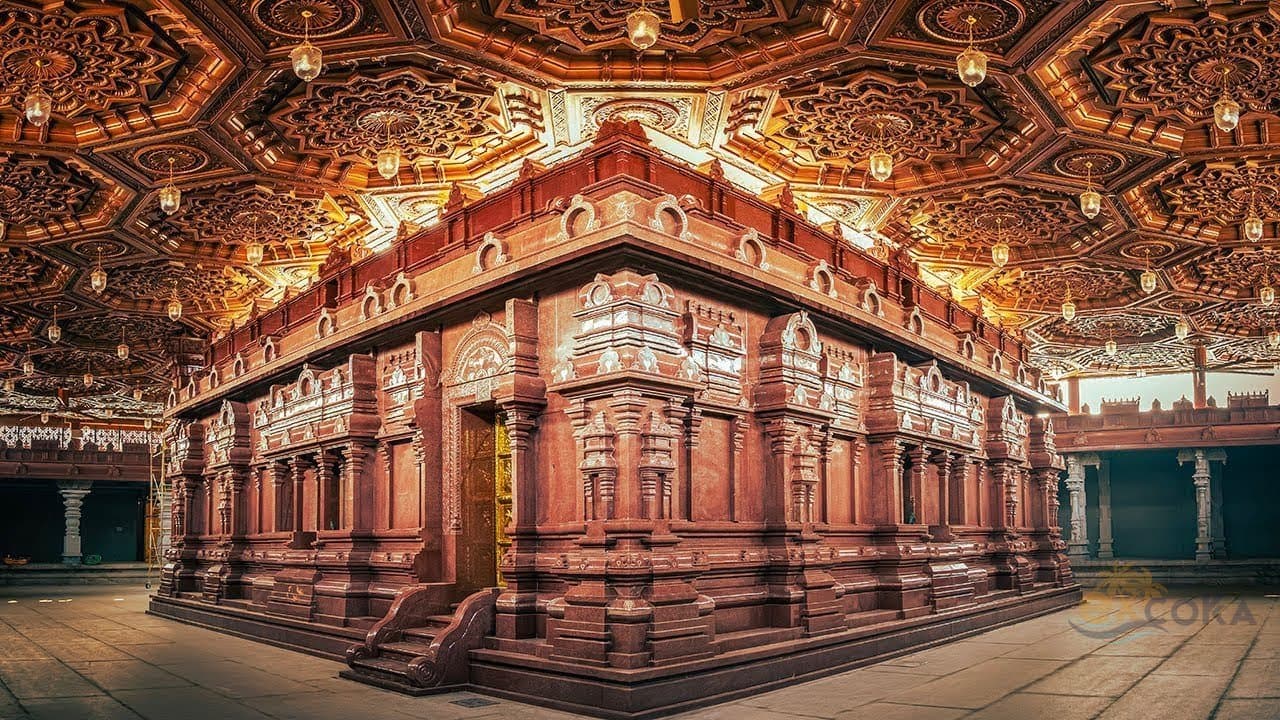
There is something unusual about Kapu Marigudi Temple.
Walk into the main shrine expecting to find the usual idol, and you might find yourself looking twice.
Instead of a permanent statue of the goddess, the centre of the sanctum has the Gaddige, an ornate throne. During daily worship, a Kalasha, a sacred vessel, is placed on it and worshipped as the presence of the goddess.
For a visitor, it can take a moment to understand.
For devotees, there is nothing unusual about it.
The goddess is Mariyamma, also known as Dandinamari, and the belief surrounding the temple is that she does not need a permanent physical form to be present.
It is a simple idea, but a powerful one.
The Goddess of Protection
Kapu is a coastal town known for its beautiful beach and historic lighthouse, but its connection with the goddess runs much deeper.
Local traditions associate the goddess with protection and the well-being of the community. The temple has long been a place where people come seeking blessings, particularly during times of illness, uncertainty and difficulty.
There are also different local accounts about the history of the temple and its connection with the old Manohara Gadha fort built during the Keladi period.
One of the stories says that the goddess remained connected with the place even after the fort and its military importance faded.
Another local tradition speaks of a divine message received by an administrator, which eventually led to the establishment of the shrine with the participation of people from different communities.
Whether you look at these stories as history, legend or a mixture of both, they point towards the same idea: the temple has always been closely tied to the people of Kapu.
A Goddess Who Takes a Temporary Form
Perhaps the most fascinating part of Kapu Marigudi is the way the goddess is represented during the Maari Pooja.
During these important rituals, a temporary wooden idol known as Hongaraka is created and beautifully decorated, including with jasmine flowers.
The idol is used for the duration of the ritual and is then ceremonially set aside.
It isn't treated as a permanent object to be preserved forever.
Instead, the temporary form comes into existence for the ritual and then passes away.
The temple celebrates three major Maari Poojas during the year:
Suggi Maari Pooja, around March
Aati Maari Pooja, during the monsoon season
Jarde Maari Pooja, around November
Each is connected with the seasonal rhythm and religious traditions of the community.
During Navaratri, the temple takes on a different atmosphere altogether, with special rituals, yagas and cultural programmes bringing more devotees to the temple.
A Temple That Feels Connected to the Community
Kapu Marigudi is not only about its unusual form of worship.
Like many traditional temples in coastal Karnataka, its importance comes from the community that surrounds it.
People return year after year for festivals and rituals. Families carry traditions forward, while devotees continue to pass stories about the goddess from one generation to the next.
And then there is Annadana.
Food is served to devotees, creating a simple but meaningful sense of community. Everyone sits down together, and for that meal, there is no need to ask where someone came from or how long they have been a devotee.
You simply sit, eat and become part of the moment.
Plan Your Visit
If you're planning to visit Kapu Marigudi, the temple is open for darshan during the following hours:
Morning: 5:00 AM – 12:00 PM
Evening: 4:00 PM – 9:00 PM
The temple also follows a regular schedule of special rituals, including Usha Kala Pooja at 8:30 AM and Lalitha Archane at 12:30 PM.
Tuesdays are particularly significant for devotees, with Annadana beginning at 12:30 PM.
If you're visiting during Maari Pooja, Navaratri or another major festival, it is worth checking the day's schedule locally, as timings and rituals may vary.
Why Kapu Marigudi Is Worth Visiting
Kapu is already a popular stop for its beach and lighthouse.
But just a short distance from the sea is a temple with a story that is quite different from what you might expect.
There is no permanent idol at the centre of the shrine.
There is a throne.
There is a Kalasha.
There are temporary forms created for important rituals.
And there are generations of devotees who continue to believe that the goddess is present regardless of the form she takes.
That is what makes Kapu Marigudi special.
It reminds us that faith does not always need a permanent shape.
Sometimes, a throne is enough.