There are temples you visit.
And then there are temples that seem to belong to the landscape itself.
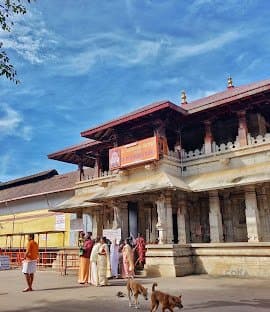
Sri Mookambika Temple at Kollur is one of them.
Nestled at the foothills of Kodachadri, surrounded by the forests and rivers of the Western Ghats, the temple has been a centre of devotion for generations. For pilgrims, it is a sacred destination. For others, it is a place where mythology, history, architecture, and the natural world come together in an extraordinary way.
But to understand Kollur Mookambika, it helps to look beyond the temple building.
Its story begins with a legend.
The Legend of Mookambika
According to traditional accounts, the region was once associated with Sage Kola, who worshipped a powerful linga in the forest.
The story tells of a demon named Kumbhasura, who performed severe penance seeking a powerful boon from Lord Shiva.
The Goddess intervened before he could receive the boon he desired, rendering him mooka—unable to speak.
Kumbhasura became known as Mookasura and continued to trouble the sages and people of the region.
The Goddess eventually defeated him at a place traditionally identified as Maranakatte, near Kollur.
According to the legend, Mookasura repented before his death and asked the Goddess to remain in Kollur.
She did.
And she came to be worshipped as Mookambika.
This story is part of the sacred tradition surrounding the temple and helps explain the name and identity of the Goddess worshipped here.
A Goddess Who Represents Shiva and Shakti
What makes the Mookambika shrine particularly distinctive is its association with both Shiva and Shakti.
At the centre of the sanctum is the sacred Udbhava Linga, described in traditional accounts as self-manifested. A golden line, known as the Suvarna Rekha, is said to divide the visible portion of the linga, symbolically representing the principles of Shiva and Shakti.
The Goddess Mookambika is traditionally understood as being united with this sacred linga.
This makes the shrine more than a conventional image of the Goddess.
It represents the meeting of two divine principles—Shiva and Shakti as one.
The Adi Shankaracharya Connection
One of the most important chapters in the temple's traditional history is its connection with Adi Shankaracharya.
According to longstanding tradition, Shankaracharya came to the Kollur region and performed penance in the vicinity of Kodachadri. He is also traditionally believed to have consecrated the image of Goddess Mookambika at Kollur.
Karnataka Tourism records this association and notes that Shankaracharya is believed to have visited the temple to perform penance and consecrated the deity.
The nearby Kodachadri hills continue to carry this association. Local and tourism traditions identify the mountain as a place connected with Shankaracharya's meditation and spiritual practices.
Whether experienced through history, philosophy, or faith, the connection gives Kollur another layer of significance.
The temple isn't simply a place of worship.
It is also part of a much larger intellectual and spiritual landscape associated with one of India's most influential philosophers.
A Temple Surrounded by the Western Ghats
Perhaps one of the most remarkable things about Kollur is the setting.
The temple stands amid the greenery of the Western Ghats, near the base of Kodachadri. Rivers, forests, hills, and waterfalls surround the region.
The Souparnika River flows near Kollur, adding another important element to the spiritual landscape.
The surrounding Mookambika Wildlife Sanctuary protects a large expanse of Western Ghats forest and is home to diverse flora and fauna.
This landscape matters.
For centuries, sacred places were not always separated from nature.
They existed within it.
At Kollur, that relationship remains visible.
You leave the temple and almost immediately encounter forests, hills, flowing water, and the sounds of the Western Ghats.
The journey to the temple becomes part of the experience.
The Architecture of the Temple
The temple itself reflects the architectural traditions that developed around sacred spaces in this region.
Its copper-covered roofs and gold-plated crest stand out against the surrounding greenery, giving the temple a distinctive appearance.
But architecture here is not simply decoration.
The temple has evolved as a living place of worship, shaped by rituals, festivals, devotees, and generations of religious practice.
That is what makes visiting different from walking through a historical monument.
The building is not frozen in time.
It is still being used for the purpose for which it has been revered for generations.
Why Kollur Matters to Devotees
For devotees, Mookambika is deeply associated with Shakti, wisdom, strength, and divine grace.
Families visit the temple seeking blessings for important moments in life. Children are brought here. Special prayers are performed. Festivals bring large numbers of devotees together.
The temple's annual celebrations, including its Rathotsava, form an important part of Kollur's cultural calendar.
For many visitors, however, the significance of Kollur is difficult to explain in words.
It is something experienced rather than described.
The early morning atmosphere.
The sound of bells.
The fragrance of incense.
The movement of devotees through the temple.
The forested hills beyond the town.
The Souparnika flowing nearby.
All of these become part of the experience.
Kollur Is More Than the Temple
One of the reasons Kollur deserves more than a quick pilgrimage stop is its surroundings.
The temple sits at the gateway to a landscape that includes Kodachadri, the Mookambika Wildlife Sanctuary, forests, rivers, and waterfalls.
This creates an unusual combination.
You can begin the day with a temple visit, spend time beside the river, explore the surrounding forests, and look towards the Western Ghats before the day is over.
Here, spirituality and nature don't compete with each other.
They exist side by side.
A Living Story
The history of Kollur Mookambika Temple cannot be separated completely from its legends.
The story of Mookasura.
The worship of the sacred linga.
The connection with Adi Shankaracharya.
The traditions surrounding the Goddess.
The forests of Kodachadri.
The generations of families who continue to visit the temple.
Some of these belong to recorded history.
Others belong to sacred tradition and belief.
But together, they form the story that has given Kollur its identity.
And perhaps that is the most interesting thing about ancient temples.
Their history isn't only found in inscriptions, architecture, or books.
Sometimes, it survives in the stories people continue to tell.
A Journey to Kollur
Kollur Mookambika Temple is not simply a destination for those seeking a religious experience.
It is a place where mythology, spirituality, landscape, architecture, and living tradition come together.
You arrive through the forests of the Western Ghats.
You enter a town shaped by pilgrimage.
You stand before a deity worshipped for generations.
And when you leave, the mountains and forests remain around you.
Perhaps that is why Kollur stays with people.
Not because it tells only one story.
But because every visitor seems to take away a slightly different one.
Discover the Stories Behind the Places
At Excoka, we believe travel becomes more meaningful when you understand the stories behind the places you visit.
Kollur is not just a temple on a map.
It is a story of faith, legend, philosophy, nature, and generations of people who continue to keep that story alive.
Come discover Kollur.
Discover the places. Understand the stories. Experience Tulunadu.
Excoka — Discover Tulunadu. Discover the stories behind the places.