In Tulunadu, festivals are not simply occasions marked on a calendar. They are living traditions—woven into the land, the seasons, the forests, and the communities that have preserved them for generations.
Nagarapanchami, the festival dedicated to the worship of Naga Deva, is one such tradition.
Celebrated on the fifth day of the bright half of the Hindu month of Shravana, Nagarapanchami holds a special place in many parts of India. In Tulunadu, however, the festival has a particularly deep connection with sacred Naga Deva groves, ancestral traditions, village communities, and the relationship between people and nature.
What is Nagarapanchami?
Nagarapanchami is traditionally associated with the worship of Naga Deva.
On this day, devotees offer prayers to Naga Deva deities and seek blessings for prosperity, protection, fertility, and the well-being of their families. The rituals and customs vary across different regions, but the reverence for the Naga remains central to the festival.
The Naga Deva occupies an important place in Indian mythology and symbolism. Nagas are associated with water, fertility, protection, the earth, and powerful natural forces.
But Nagarapanchami is not only about the worship of a particular animal.
At its heart, the festival reflects an older idea:
Human life is deeply connected with the natural world.
The Stories Behind Nagarapanchami
Like many Indian festivals, Nagarapanchami is associated with several stories from Hindu mythology rather than a single origin story.
One well-known story comes from the Mahabharata.
King Janamejaya is said to have conducted a great Naga Deva sacrifice, known as the Sarpa Satra, seeking to destroy the Naga Deva race. According to the legend, the sage Astika intervened and persuaded the king to stop the sacrifice, saving the Naga Deva from destruction.
The story is remembered as an example of intervention, compassion, and the importance of preventing unnecessary destruction.
Another popular story connects Naga Deva worship with Lord Krishna and Kaliya, the serpent who lived in the Yamuna River.
According to the legend, Kaliya's presence had poisoned the river and endangered the surrounding community. Krishna confronted Kaliya, subdued him, and ultimately allowed him to leave the river.
The stories differ in their details and interpretations, but they share an underlying theme:
Respect the forces of nature rather than treating them as something to be conquered.
Why Are Naga Deva Worshipped?
For communities living close to forests and agricultural land, snakes have always been part of the surrounding ecosystem.
Many snake species help control populations of rodents and other animals that can affect agriculture. Snakes are also deeply connected with traditional Indian symbolism surrounding water, fertility, protection, and the earth.
Over centuries, ecological realities and religious traditions became intertwined.
Nagarapanchami therefore offers an interesting perspective on how traditional societies understood their relationship with wildlife.
It does not mean that every traditional belief about snakes should be interpreted as scientific fact. Rather, the festival demonstrates how cultural practices can encourage respect for creatures that people share their environment with.
Nagarapanchami in Tulunadu
The story becomes particularly fascinating in Tulunadu, where Naga Deva worship has developed a distinctive cultural identity.
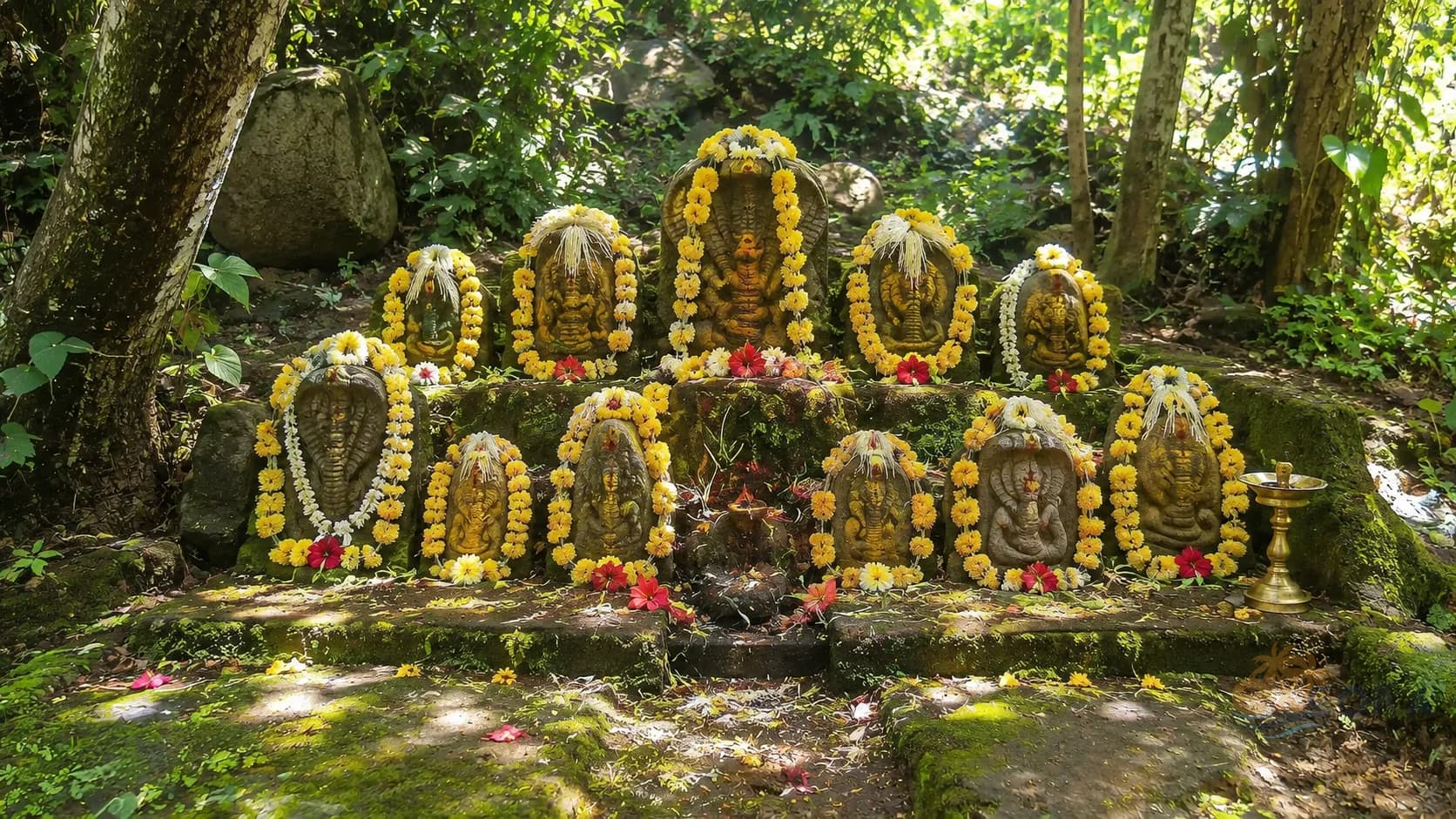
Across Tulunadu, one can find Nagabanas—sacred spaces traditionally associated with Naga Deva deities.
Unlike conventional temples built entirely of stone and concrete, a Nagabana may be a naturally preserved grove of trees surrounding Naga Deva stones or shrines.
These places carry both spiritual and ecological significance.
Generations of families and communities have traditionally protected such spaces because they are considered sacred.
The result is a fascinating relationship between belief and landscape: a patch of forest is protected not simply because it is useful, but because it is sacred.
A Nagabana can look deceptively simple.
There may be trees, dense vegetation, Naga Deva stones, a small shrine, and a pathway leading into the grove.
But behind that simplicity lies generations of cultural memory.
The grove may be associated with a particular family, village, community, or ancestral tradition. Rituals and responsibilities connected to it can be passed from one generation to the next.
This makes Nagabanas more than religious sites.
They are also examples of traditional landscape conservation.
Because these spaces are protected by cultural beliefs, they can preserve vegetation and provide refuge for different forms of life.
It is a powerful reminder that conservation does not always begin with modern institutions. Sometimes, it begins with a community deciding that a particular piece of land is too sacred to disturb.
How is Nagarapanchami Celebrated in Tulunadu?
The way Nagarapanchami is observed can differ between communities and families.
Devotees visit Naga Deva shrines and Nagabanas to offer prayers. Naga Deva stones are decorated, rituals are performed, and families gather to honour their traditional deities and customs.
For many communities in Tulunadu, these celebrations remain closely connected with ancestral traditions and local customs.
The rituals are not merely performances for visitors. For many families, they are part of an inherited tradition—something their parents and grandparents practiced before them.
That continuity is what makes the festival culturally significant.
More Than a Religious Festival
There is another way to look at Nagarapanchami.
Modern life often separates people from the natural systems around them. Forests become "green spaces," rivers become "water resources," and wildlife becomes something encountered mainly in protected areas.
Traditional festivals sometimes offer a different perspective.
They remind communities that nature is part of everyday life.
A Naga Deva is not merely an animal to be feared.
A forest is not merely unused land.
A river is not merely a source of water.
These things can have cultural, spiritual, ecological, and social meaning at the same time.
That is one of the reasons traditions such as Nagarapanchami remain relevant even today.
Preserving the Tradition Responsibly
As we celebrate Nagarapanchami, there is also an opportunity to think about how traditions can be preserved responsibly.
Wild snakes should not be captured or handled for public celebrations. They are wild animals and should be allowed to remain in their natural habitats.
Likewise, sacred groves should be protected from unnecessary construction, pollution, and disturbance.
The strongest interpretation of Nagarapanchami is therefore not simply:
"Worship the Naga Deva."
It can also be:
Respect the life around you. Protect the habitats that sustain it. Preserve the traditions that connect communities to their land.
Experience the Living Traditions of Tulunadu
For a traveller, festivals such as Nagarapanchami offer something that conventional sightseeing cannot.
You can visit temples, beaches, waterfalls, and historic places—but experiencing a traditional festival provides a glimpse into how the people of Tulunadu understand their land, culture, and heritage.
The landscape itself becomes part of the story.
The monsoon-soaked villages.
The coconut groves.
The ancient shrines.
The Nagabanas hidden among trees.
The families preserving traditions passed down through generations.
This is the side of Tulunadu that deserves to be discovered slowly and respectfully.
When we preserve our traditions, we also have an opportunity to preserve the relationship between people, culture, and nature.
Happy Nagarapanchami from Excoka.
Discover Tulunadu. Discover the stories behind the places.