There are places you visit for their beauty, places you visit for their food, and then there are places whose stories stay with you long after you leave.
Udupi is one of them.a
At the heart of this coastal town stands the Sri Krishna Matha, a place that has drawn devotees, philosophers and travellers for centuries. Thousands visit every day to catch a glimpse of Lord Krishna, but not everyone knows the fascinating story behind the idol worshipped here.
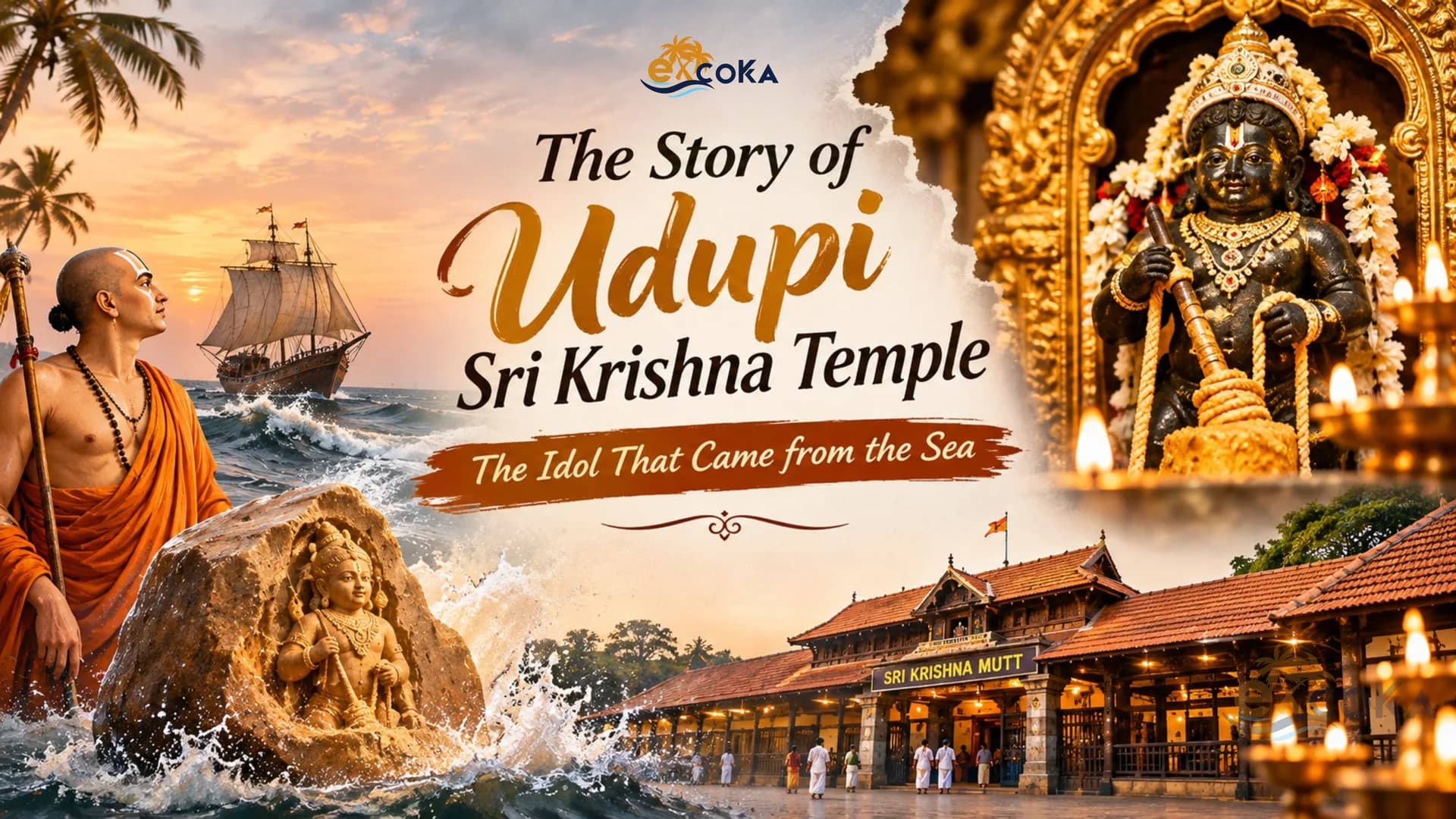
It is a story of a saint, a ship caught in a storm, a block of sacred clay and an idol that, according to tradition, travelled across the Arabian Sea before finding its home in Udupi.
And it all begins with Sri Madhvacharya.
A Saint Who Changed Udupi's History
To understand the story of the temple, we first need to go back to the 13th century.
Sri Madhvacharya was a philosopher and spiritual teacher born in Pajaka, near present-day Udupi. He went on to establish the Dvaita school of Vedanta, a philosophical tradition that teaches the distinction between the individual soul and the Supreme Being.
His influence on Udupi was profound. But among the many stories associated with his life, one stands out for its connection to the Krishna idol.
The story takes us from the streets of Udupi to the waters near Malpe.
The Ship, the Storm and the Sacred Idol
According to the traditional account, a merchant ship was sailing along the Arabian Sea, carrying a large block of Gopichandana, a sacred clay. The block was being used as ballast to keep the vessel stable.
As the ship approached the Malpe coast, it encountered a powerful storm. The vessel struggled against the rough sea, and its crew feared it might sink.
At that time, Madhvacharya was said to be meditating near the shore.
Seeing the ship in distress, he is believed to have waved his ochre robes towards it. The storm subsided, and the ship reached the shore safely.
The grateful captain approached the saint and offered him valuable gifts as a gesture of thanks. Madhvacharya declined them. Instead, he asked for the large block of Gopichandana being carried on the ship.
The captain agreed.
What happened next is the part that makes this story unforgettable.
When the sacred clay was immersed and washed, an idol of Lord Krishna emerged from within it. The idol depicted Krishna as a young child, holding a churning rod in one hand and a rope in the other.
Madhvacharya recognised its divine significance and brought the idol to Udupi, where he consecrated it and established a shrine for its worship.
This is the traditional story of how the Krishna idol came to Udupi. The temple's foundation in the 13th century by Madhvacharya is part of its established history, while the ship and Gopichandana account belongs to its religious tradition.
Why Does Udupi Krishna Hold a Churning Rod?
Take a closer look at the idol of Lord Krishna at Udupi.
Unlike the familiar depictions of Krishna playing the flute or standing with Radha, the deity here appears as a little child holding a churning rod, known locally as Kadagolu, and a rope.
The image represents Bala Krishna, the child Krishna associated with the stories of butter and his childhood in Gokula.
There is something special about this depiction. The deity is not presented as a king or a warrior, but as a playful child.
It is this form of Krishna that devotees have worshipped in Udupi for generations.
Eight Mattas, One Temple and a Living Tradition
Madhvacharya did not simply establish a shrine and leave its worship to chance. He entrusted its care to eight of his disciples, who went on to establish the eight monasteries known as the Ashta Mattas.
These are:
Palimaru Matha
Adamaru Matha
Krishnapura Matha
Puttige Matha
Shirur Matha
Sode Matha
Kaniyooru Matha
Pejavara Matha
The eight Mattas continue to play a central role in the temple's administration and worship.
One of the most distinctive traditions associated with them is Paryaya.
Every two years, the responsibility of worshipping Lord Krishna and managing the temple passes from one Matha to another. The transition is marked by a grand celebration in Udupi, bringing together devotees, religious leaders and visitors.
The present two-year Paryaya system was formalised by Sri Vadiraja Tirtha in 1522 CE.
It is a remarkable tradition that has kept the temple's religious and institutional life connected across generations.
The Window That Changed the Way Devotees See Krishna
There is another story at the temple that deserves its own place.
Walk around to the western side of the Krishna shrine, and you will find a small window known as Kanakana Kindi.
Its story is connected to the 16th-century saint-poet Kanakadasa.
According to tradition, Kanakadasa came to Udupi seeking the blessings of Lord Krishna. However, he was denied entry into the temple because of the caste barriers of that time.
He did not leave. Instead, he stood outside the temple and continued praying to Krishna.
The legend says that Lord Krishna turned towards Kanakadasa, and an opening appeared in the western wall, allowing him to receive darshan.
That opening came to be known as Kanakana Kindi.
Today, devotees view the deity through the Navagraha Kindi, a silver-plated window with nine openings. The story of Kanakadasa remains one of the most powerful parts of Udupi's temple tradition, reminding visitors that devotion cannot be measured by social position.
More Than a Temple, It Is the Heart of Udupi
Step outside the shrine, and you will notice that the temple is much more than a place for prayer.
There is Madhva Sarovara, the sacred temple tank. There are the surrounding Mattas, the traditional streets, the sound of temple bells and the steady movement of devotees.
And then there is the food.
The temple's tradition of serving Anna Prasada to devotees is an important part of its identity. The idea that a visitor should not leave the abode of Krishna hungry is deeply woven into Udupi's religious culture.
It is perhaps fitting that a town known across India for its food has a temple where feeding people is itself considered an act of devotion.
Visiting Udupi Krishna Matha
If you are visiting Udupi, the Krishna Matha is a place worth experiencing beyond a quick darshan.
Take time to explore the temple surroundings. Visit Madhva Sarovara, observe the traditional architecture and learn about the Ashta Mattas. You can also visit the nearby Anantheshwara and Chandramouleshwara temples, which are traditionally visited before seeking darshan of Lord Krishna.
And when you stand before the Navagraha Kindi, remember the stories associated with the little window. There is a lot more behind it than meets the eye.
A Story That Continues
The story of Udupi Krishna is not just about how an idol arrived at a temple.
It is about how a spiritual tradition took root in a coastal town, how eight Mattas carried that tradition forward, and how generations of devotees made the temple part of their lives.
Whether you believe every detail of the legend or simply appreciate the faith behind it, one thing is certain: the story has become inseparable from Udupi's identity.
And perhaps that is what makes this place special.
The next time someone mentions Udupi, they might talk about masala dosa, famous hotels or beautiful beaches.
But behind all of that stands a little Krishna, holding a churning rod and a rope, with a story that travelled across the sea.
Excoka. Discover Tulunadu. Discover the stories behind the places.