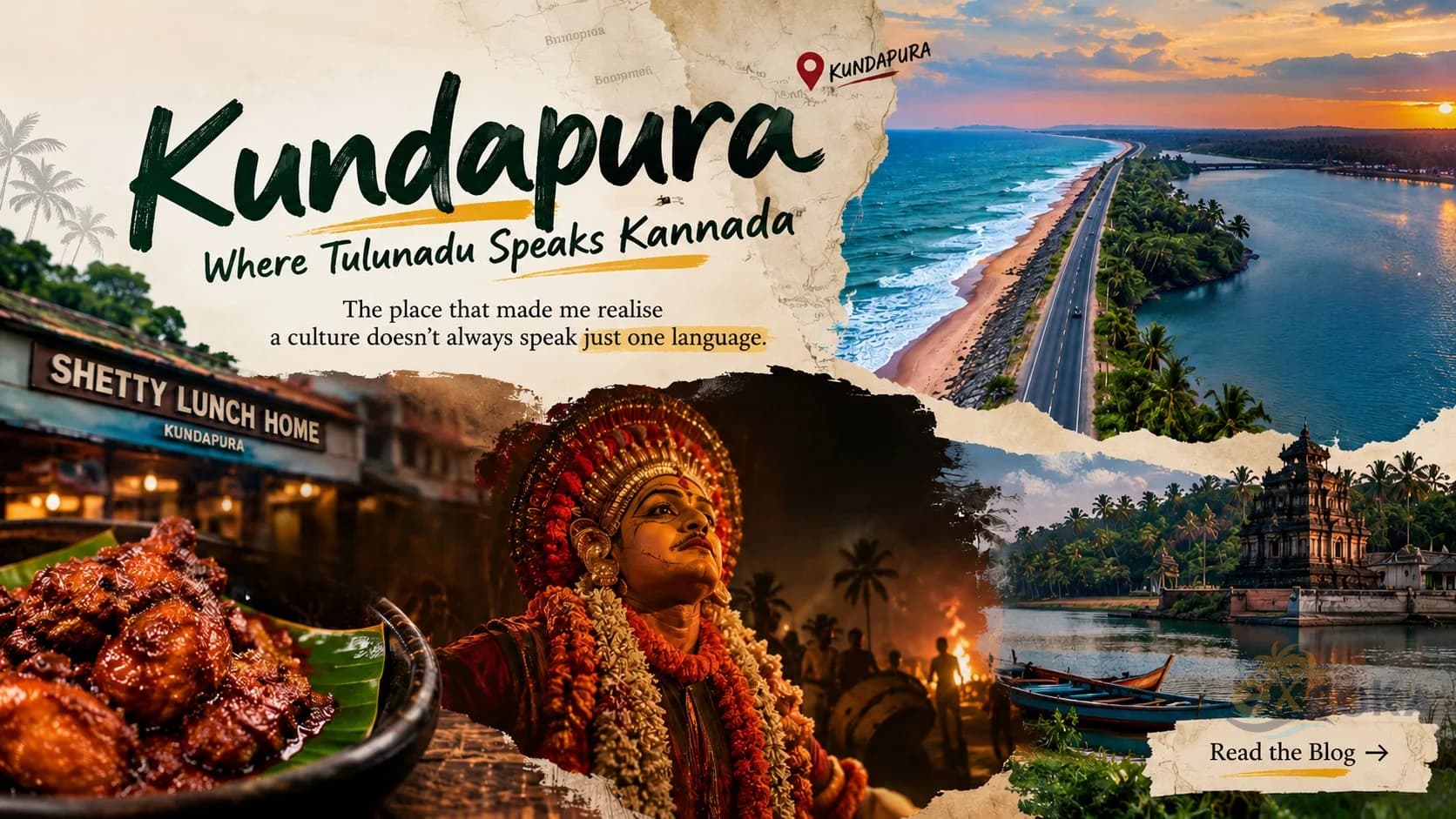
The place that made me realise a culture doesn't always speak just one language.
In my last story, I ended with a place that seemed to change the question I had been asking about Tulunadu.
Kundapura.
If Tulu is so deeply connected with the identity of Tulunadu, where does a place like Kundapura fit in?
The answer isn't as simple as a language map.
Because Kundapura tells us something interesting about this region: culture doesn't always follow language.
Welcome to Kundapura
Ask someone what comes to mind when they hear "Kundapura," and the answers might be very different.
For some, it is Maravanthe Beach, where the Arabian Sea stretches on one side while the Souparnika River flows on the other. It is one of those landscapes that almost looks too carefully designed to be real.
For food lovers, Kundapura immediately brings to mind Shetty Lunch Home's Chicken Ghee Roast. A dish born in this part of the coast that has travelled far beyond it.
And for a whole new generation, there is another connection.
Rishab Shetty.
Through Kantara, he brought the landscapes, beliefs, rituals, forests and communities of this part of Karnataka to audiences far beyond the coast. Suddenly, traditions that many of us grew up seeing around us became something the rest of the country wanted to understand.
But Kundapura is much more than beaches, food and cinema.
It is a place with its own language, its own rhythm and its own cultural identity.
Travel north from Udupi and you'll begin to notice something fascinating.
The Tulu you've been hearing starts to give way to Kundapura Kannada, a distinctive regional form of Kannada with its own expressions, pronunciation and character.
And that is where things get interesting.
Because geographically, historically and culturally, Kundapura sits within the larger world of Tulunadu, yet its linguistic identity is different.
So, Is Kundapura Part of Tulunadu?
This is where things get a little complicated.
Regions are rarely as neat as the lines we draw on maps.
Tulunadu is often associated with the areas where Tulu has historically been spoken, but its cultural boundaries have always been broader and more fluid than language alone can explain.
Kundapura is a good example.
The region has its own linguistic identity, but many of the cultural patterns that surround it connect naturally with the wider coastal world.
The temples.
The festivals.
The relationship with agriculture and the sea.
The stories passed through generations.
These things don't disappear when a language changes.
And that made me think about my own understanding of Tulunadu.
I had always associated a place with its language.
Kundapura taught me that perhaps I was looking at it the wrong way.
A Culture Doesn't Need One Language
Think about it.
A culture is not a dictionary.
It is something people live.
It exists in the way a grandmother tells a story.
In the way a family prepares a festival meal.
In the way a village gathers around a temple.
In the way farmers understand the seasons.
In the way fishermen read the sea.
In the way old traditions survive even when the world around them changes.
Language is one part of that identity.
But it isn't the whole thing.
Kundapura is a beautiful example of that complexity.
Here, Kannada has its own local flavour, while the surrounding cultural landscape carries influences and traditions that belong to the broader coastal world.
Perhaps that is why trying to draw a perfect cultural boundary around Tulunadu can be difficult.
The culture doesn't stop at a line.
It blends.
It evolves.
It travels.
But the more I explored Kundapura, the more I realised that this was only one piece of a much bigger story.
Did you know that there are 8 known languages and language varieties spoken across Tulunadu?
Kundapura showed us that a different language doesn't necessarily mean a different culture.
So now the question becomes even more interesting:
What are the other voices of Tulunadu, and what stories do they carry?
Maybe the next one will take us somewhere we don't expect.