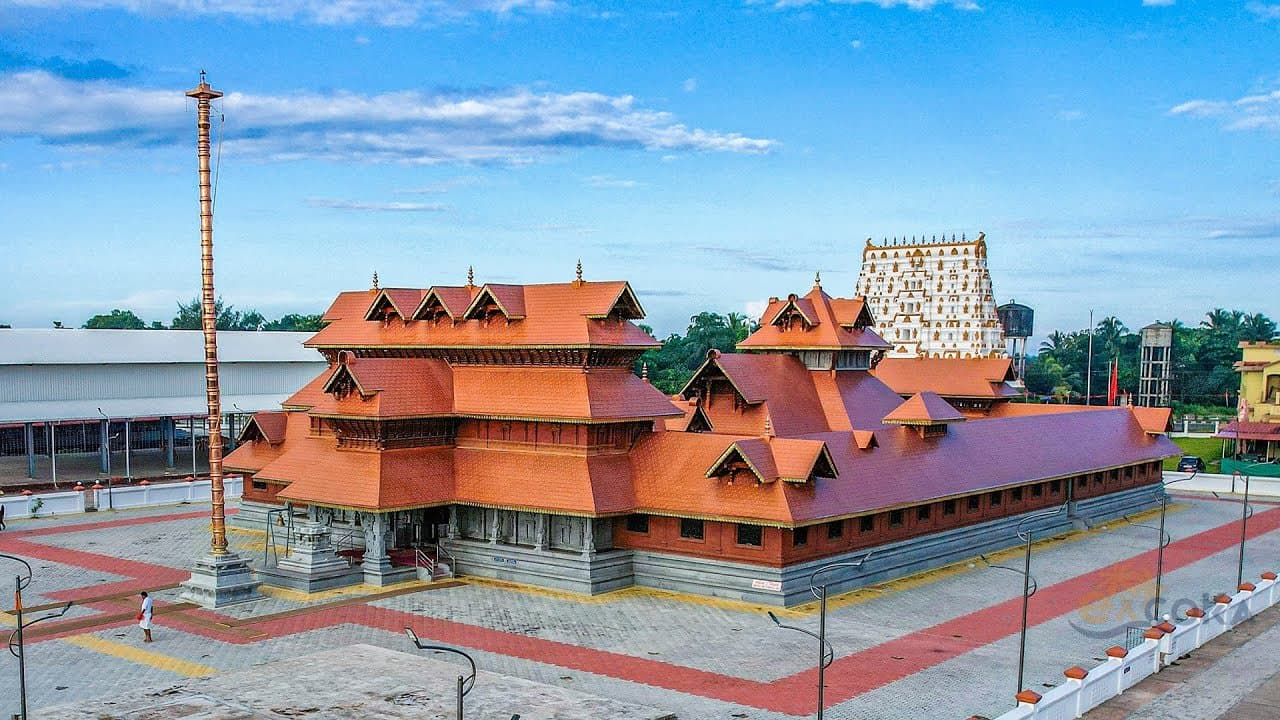
I visited Uchila Shree Mahalakshmi Temple during Navaratri, when the whole complex seemed to be holding its breath between one wave of devotees and the next. The goddess was draped in silk, gold catching every lamp in the sanctum, the air thick with camphor smoke and marigold. I had come expecting noise and color, and I found both -but it was something quieter, on the edge of all that celebration, that I ended up carrying home with me.
I met him near the sacred lake, an old man in a faded white shirt, sitting so still I almost mistook him for part of the architecture, undisturbed by the crowds moving past him toward the sanctum. I had wandered off from the main festivities, drawn by the quiet on that side of the complex, and when I sat down a respectful distance away, he spoke without turning his head. "First time at Uchila? During Navaratri, no less." I nodded. He smiled like he'd expected as much, and then, without my asking, he began to talk.
"This Temple Was Built by People Like Me"
"My father was a fisherman," he said, "and his father before him, and his father before that. Every one of them, before they left for the sea, stood at this temple first." He gestured toward the sanctum behind us. "Not because a king told them to. Because they needed somewhere to put their fear."
He told me the temple was founded in 1957 by Kula Guru Sri Madhava Mangala, a spiritual leader of the Mogaveera community -the fisherfolk of this coast, his community, he said, patting his chest as he said it. The land, he added, was gifted by a man named Sadiya Sahukar, freely, the way things were sometimes still given back then. "No emperor built this place," the old man said. "Fishermen's families did. That's why, when you sit here, it doesn't feel like a monument. It feels like home."
He mentioned, almost as an afterthought, that people now call it the third most revered Mahalakshmi temple in the country, after Kolhapur and Mumbai. He shrugged at the rank. "Numbers don't mean anything to the sea," he said. "What matters is she's always been here when we needed her."
"Look at the Walls. Somebody's Whole Life Is in Them"
He pointed toward the sanctum's copper-clad granite walls, catching the afternoon light in a way that made the whole structure seem to breathe. "My grandfather used to say a carver spent years on those wood panels inside," he told me. "Not months. Years. Sit in front of them long enough and you'll understand why -every line is deliberate, nothing rushed." He compared them, proudly, to the carvings at Belur and Halebidu, and I believed him before I'd even stepped inside to check.
He walked me, slowly, through the six-acre complex as though he owned every stone of it. The lake we were sitting beside, he said, sits to the northeast for a reason -everything here, he insisted, the Vasantha Mandapam in the southeast, the Dwajasthambam standing tall at the entrance, follows rules older than either of us, rules meant to keep the whole place in balance. "Vastu," he said, tapping the ground once, like it settled the matter. He nodded toward two smaller shrines as we passed -Bhadrakali, and Prasanna Ganapathi -"her protectors," he called them, "always close by."
"Sixteen Times a Day, Somebody Here Is Praying"
"You know how many poojas happen here, every single day?" he asked, and didn't wait for me to guess. "Sixteen." He said it the way you'd mention a fact about your own family -not showing off, just stating something he'd known his whole life. "Sunrise to night, this temple never really goes quiet."
His eyes drifted toward the sanctum, toward the goddess in her silk and jewels, gold catching every lamp in the room. "This is my favorite time of year to sit here," he said. "I was a boy the first time my father lifted me onto his shoulders during Navaratri, just so I could see her face over the crowd. Every year since, I come back to this same spot by the lake. I still remember that first time better than most things from last year." Fridays, he told me, brought the Samuhika Sathyanarayana Pooja and Shanideva Shanti, the whole neighborhood arriving together like it was less a ritual than a standing appointment with each other. But March, he said -March was different. "The Suggi Car Festival. Thousands of people pulling that chariot through the streets. You don't walk in that crowd, you're carried by it." He laughed, a short, warm sound. "Every year, I tell myself I'm too old for it. Every year, I go anyway."
"Nobody Leaves Here Hungry"
Before he stood to leave, he told me the temple opens for darshan from 6:00 in the morning until 2:30 in the afternoon, and again from 4:00 until 8:00 at night. "But come at one," he said, "even if you're not hungry. Annadana runs until three. I've eaten on that floor with fishermen, with strangers, with people who walked in not even sure why they'd come. Nobody asks who you are before they hand you a plate."
He told me, almost in passing, that the temple was only 16 kilometers from Mulki station, about 41 from the Mangalore airport -close enough, he said, that there was no excuse not to visit. Then he stood, pressed his palms together toward the sanctum one last time, and walked off toward the entrance without telling me his name.
What EXCOKA Wants You to Find at Uchila
I never learned who that man was. I don't know if he was a retired fisherman, a caretaker, or simply someone who came to sit by the lake the way he probably had for decades. But I left Uchila that afternoon carrying something I hadn't arrived with -a sense that this temple isn't a destination people visit so much as a promise a whole community keeps returning to, generation after generation, boat after boat.
This is exactly what EXCOKA wants travelers to experience -not a temple explained by a plaque, but one explained by the people who still belong to it. Come to Uchila expecting old stone and older stories. Stay long enough, and someone will likely sit down beside you and tell you both, the way that stranger told me, unhurried, unasked, and entirely from the heart.