Three things, and they are connected. The Sri Krishna Matha, a 13th century temple founded by Madhvacharya. The vegetarian cuisine that came out of that temple's kitchens and spread across India under the name Udupi. And a coastline with Malpe, Kaup, Maravanthe and the basalt columns of St Mary's Island.
Almost everything Udupi is known for traces back to the Matha. The food is temple food. The town's layout is temple layout. Even the calendar runs on the Paryaya cycle. Understanding that makes the rest of the place legible.
The Sri Krishna Matha
Founded in the 13th century by Madhvacharya, the philosopher behind the Dvaita school of Vedanta. The temple sits at the centre of town with Car Street running up to it.
What makes it unusual: you do not see the deity directly. Darshan is through the Kanakana Kindi, a nine-holed silver window. The story attached to it is that the devotee Kanakadasa, denied entry, sang from outside until the idol turned to face him and a wall cracked open. The idol still faces west, towards that window, rather than towards the main entrance.
The Ashta Mathas. Eight monasteries founded by Madhvacharya's disciples run the temple in rotation. Each takes a two-year term, and the handover ceremony is the Paryaya. Shiroor Matha took over on 18 January 2026, with Sri Vedavardhana Tirtha Swamiji on the Sarvajna Peetha. The term runs to 18 January 2028.
Anna prasada. Free meals are served daily on a banana leaf. This is not a token gesture. The Matha kitchen has fed the town for centuries, and it is where the cuisine came from.
Two more temples sit on the same square: Anantheshwara, which predates the Matha, and Chandramouleshwara. Both are worth the ten minutes.
Full detail in our Sri Krishna Matha travel guide.
Udupi cuisine
Udupi is one of the few places in India whose name became a restaurant category. A vegetarian restaurant in Mumbai or Delhi calling itself Udupi is claiming lineage from these temple kitchens, and often it is a real one. Shivalli Brahmin families trained in the Matha kitchens carried the style across the country through the 20th century.
It is sattvic and strict. No onion, no garlic, no meat. Traditionally no tomato, carrot, beetroot or cauliflower either. Cooks worked inside those limits, which is exactly why the repertoire got so wide. Fourteen separate preparations are offered to the deity daily.
What to eat: masala dosa, which Udupi has a strong claim to inventing. Neer dosa, idli, medu vada, sambar ground with fresh coconut. Goli baje, the curd and maida fritters best eaten off a roadside counter. Kadubu and pundi, steamed rice preparations. Gulla sambar made with the local Mattu brinjal.
The thing most guides get wrong: Udupi cuisine is vegetarian, but Udupi the district is not. Step out of the Matha kitchens into Malpe and you are in Tuluva seafood country, eating anjal fry, marvai sukka and kori rotti. Those are Mangalorean Tuluva dishes, not Udupi temple cuisine. Locally the distinction matters. Both are worth eating.
More in our Udupi food guide.
The coast
Udupi district holds about 98 km of coastline. Four stretches matter to visitors.
Malpe, 6 km west of town. The busiest beach here, with lifeguards, water sports in season, a working fishing harbour and the jetty for the St Mary's Island ferry.
St Mary's Island, a set of small islands off Malpe with columnar basalt formations produced by volcanic activity. It is a National Geological Monument. Access is by ferry from Malpe Jetty, and only in season.
Kaup, 15 km south, with a white lighthouse from 1901 that you can climb. Better sunsets than Malpe and fewer people.
Maravanthe, about 55 km north, where NH 66 runs with the Arabian Sea on one side and the Souparnika river on the other. It is one of the more striking stretches of road on this coast.
Padubidri, south of Kaup, holds Blue Flag certification, the first beach in Karnataka to get it.
Then there are the quiet ones: Kodi Bengre and Delta Beach, where the Suvarna river meets the sea, and the backwaters at Kemmannu with its hanging bridge. These are where the homestays are rather than the day trippers.
One caution that applies to the whole coast. Rip currents here are serious and they kill visitors most years. Swim only where lifeguards are posted and only between the flags. Delta Beach in particular is not swimmable at all because of sinking sand at the estuary.
The culture most visitors never see
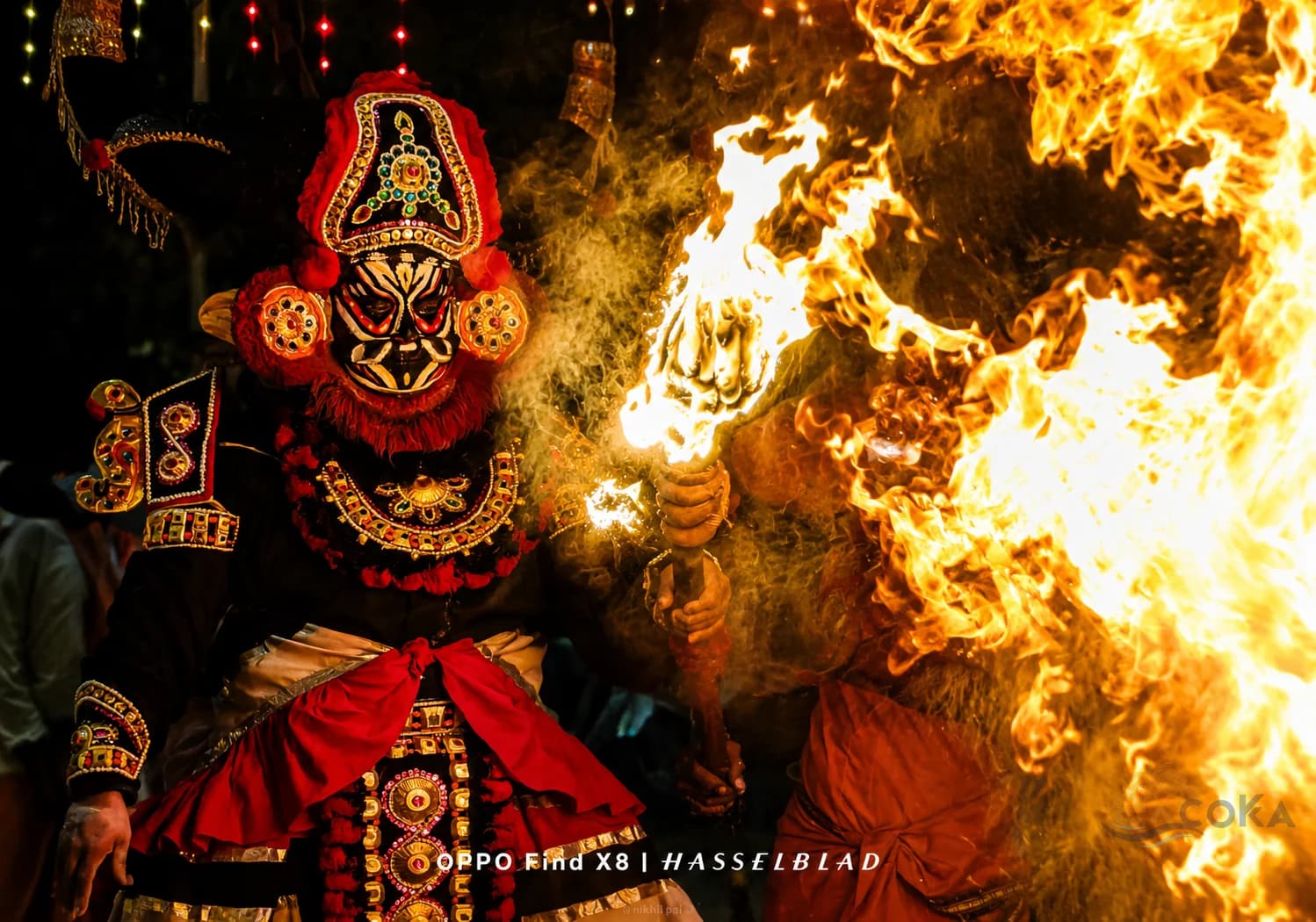
Yakshagana. A night-long dance-drama form with painted faces, towering headgear and live percussion. Udupi district works in the badaguthittu, or northern, style. More than 40 touring troupes, called melas, run their annual tirugata through the agrarian off-season, roughly November to May, with performances starting around mid November. Troupes attached to the Mandarthi, Saligrama and Amruteshwari temples are among the ones based near Udupi. If you are here in that window, ask locally. A real village performance is nothing like a stage excerpt for tourists.
Bhoota Kola. A Tuluva spirit-possession ritual, performed in the same season. It is a community religious event, not a show. If you are invited, go. Do not go looking for one to photograph.
Kambala. Buffalo racing through flooded paddy tracks, held across the Tulunadu belt from roughly November to March.
Pattanaje, in late May, is the structural close of the Tulu ritual season. Yakshagana troupes wrap up, ritual performances pause, and the coast turns towards the monsoon.
What is famous to buy in Udupi
Three Udupi products carry a Geographical Indication tag from the Government of India, which makes this the only shopping list here backed by a registry rather than a review site.
Udupi Sarees, handloom cotton woven in the district
Udupi Mattu Gulla, the round green brinjal grown at Mattu village
Udupi Malligae, the local jasmine, sold by strung length rather than by weight
Detail on all three in our what to buy in Udupi guide.
Is Udupi worth visiting?
Yes, with one condition attached: it depends on the season, and right now the answer splits.
What is closed in August
The district administration suspends boat services, water sports and access to St Mary's Island under Harbour Craft Rules, typically from around 15 or 16 May to 15 September. Reopening is a district call rather than a fixed calendar date. In 2025 the island reopened on 22 September, a week later than scheduled, because the sea was still rough. Confirm locally before building a trip around it.
What is fully open
The Sri Krishna Matha and the Ashta Mathas, year round, and arguably at their best in the rain
Anantheshwara and Chandramouleshwara
The Ghats above the coast. Agumbe, Jomlu Teertha and Kudlu Teertha are at full flow
The backwaters on the Suvarna and Sita rivers
The verdict
Worth it in August for temples, food, waterfalls and green. Not worth it if you booked for the island or for swimming. For that, come November to February.
The wider timing picture is in our best time to visit Udupi guide.
Planning your visit
How long do I need? Two days for most people. Full answer in how many days in Udupi.
When should I go? December and January, or October if you want fewer people. Full answer in best time to visit Udupi.
How do I get there? Fly to Mangaluru (IXE), 60 km south. Full answer in how to reach Udupi.
Where should I stay? Malpe for the beach, town for the temple, Bengre for quiet. Full answer in where to stay in Udupi.
Udupi or Mangalore? Fly into Mangalore, sleep in Udupi. Full answer in Udupi or Mangalore.
Is it safe? Yes. The sea is the risk, not crime. Full answer in is Udupi safe.
What is nearby? Agumbe, Kollur, Kudremukh and Maravanthe. Full answer in day trips from Udupi.
Frequently asked questions
What is Udupi best known for? The Sri Krishna Matha and the vegetarian cuisine that came out of its kitchens, including masala dosa.
Why is Udupi hotel food famous? Because Shivalli Brahmin cooks trained in the Matha kitchens opened vegetarian restaurants across India through the 20th century, carrying the name with them.
Is Udupi a religious place or a beach destination? Both, and they are 6 km apart. The town is a major Vaishnava pilgrimage centre. Malpe, Kaup and Maravanthe are on the same trip.
How old is the Udupi Krishna temple? It dates to the 13th century, founded by Madhvacharya. Anantheshwara temple on the same square is older still.
Is Udupi worth visiting in monsoon? For temples, waterfalls and green, yes. For beaches and St Mary's Island, no. Access is suspended from roughly mid May to mid September.