I still remember the first time I saw him.
I was seven, wedged between my father and the bus window, half asleep on the long ride from Gokarna, when my father's hand suddenly gripped my shoulder.
"Look."
I looked.
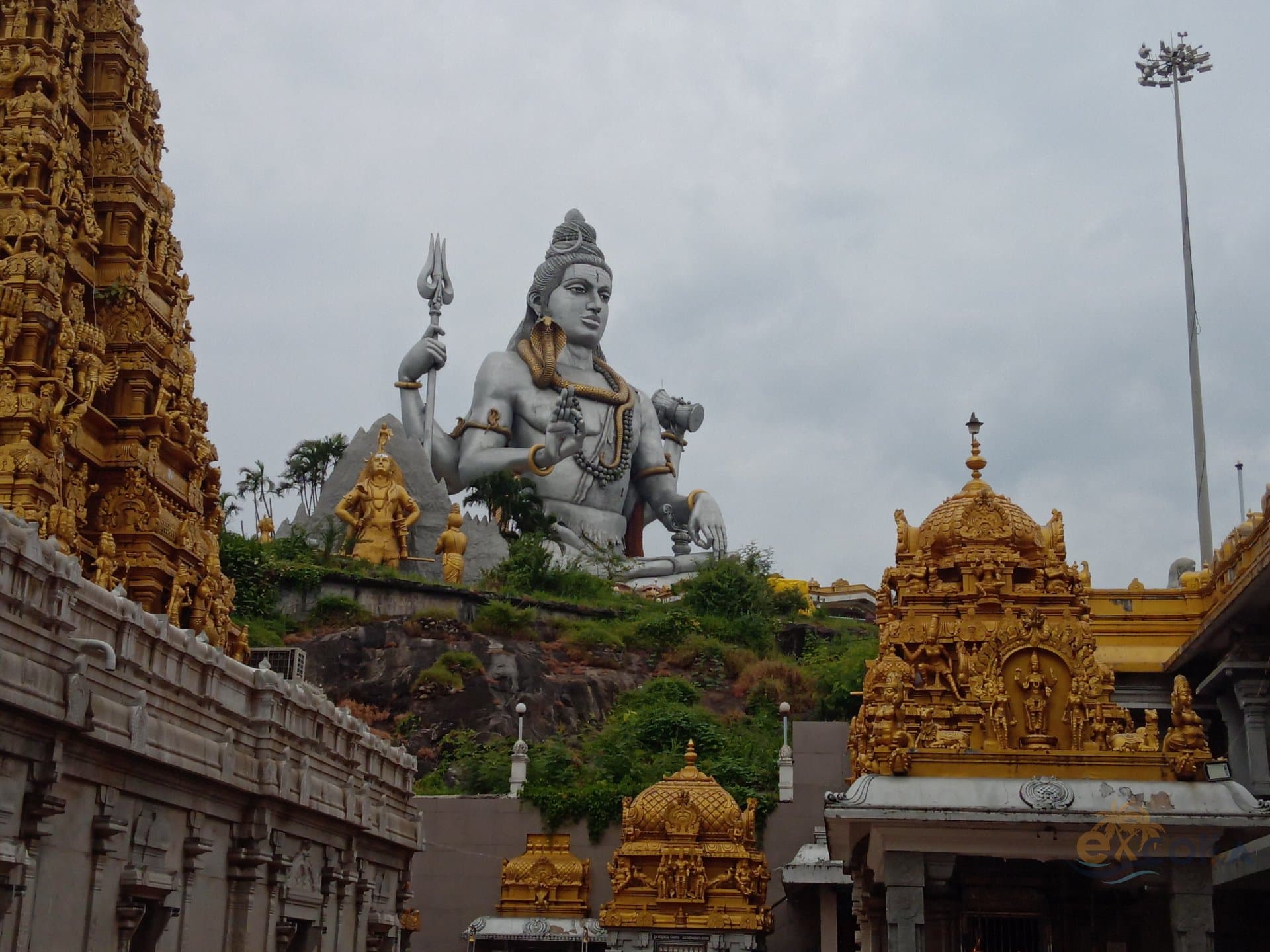
There, rising against the coastline, was Shiva.
Enormous. Utterly still. Watching the sea as though he had been watching it forever.
I didn't understand, at seven, what I was looking at. I only knew that something inside me had suddenly gone quiet.
I have been back to Murudeshwar more times than I can count since then, and that feeling has never quite left.
A Hill That Remembers
Every place in Tulunadu and the surrounding Karavali carries its stories close. Murudeshwar wears its story almost visibly.
My grandmother told me the legend the way grandmothers tell stories—half legend, half warning, and entirely certain.
According to local tradition, Ravana obtained the sacred Atmalinga from Lord Shiva and began carrying it with him. The gods feared what would happen if Ravana retained it, so Ganesha is said to have intervened and tricked him into placing the linga down.
Once placed on the ground, the Atmalinga could not be moved.
The legend goes on to connect the surrounding landscape with the sacred story, including the hill where the Murudeshwar temple now stands.
As a child, I thought it was simply another story.
Now, standing there as an adult, I see something different.
Ask someone from the area about the legend—a priest lighting the evening lamps, a fisherman nearby, or someone selling flowers outside the temple—and they often tell it with the familiarity of something that has been passed down for generations.
In this part of the world, mythology doesn't live only in books.
It lives in conversations.
Standing Beneath Something Larger Than Yourself
There is a particular silence that comes over people when they stand beneath the Shiva statue.
I've watched it happen to strangers, tour groups, and children who were running around moments earlier.
You look up and keep looking.
The trident.
The serpent.
The calm expression.
The sheer scale of the statue against the sky.
And somehow, something inside you becomes quieter too.
Beside it rises the Raja Gopura, with its towering architecture and viewing gallery overlooking the Arabian Sea.
I remember taking the lift up for the first time and laughing at the idea of having a lift inside a temple complex.
Then I stepped out and forgot what I had been laughing about.
The sea stretched endlessly on one side.
On the other, the coastline unfolded beneath me—rooftops, roads, palm trees, and fishing boats scattered across the landscape.
The wind was strong enough to make you hold on.
But more than anything, it made you look.
And for a few minutes, it made you feel very small.
In the best possible way.
The Murudeshwar Beyond the Postcard
Most visitors come, see the statue, visit the temple, take photographs, and leave.
I understand why.
Murudeshwar is difficult to ignore.
But the Murudeshwar I remember isn't only the one people photograph from the highway.
It's the beach below the hill, where fishing boats rest on wet sand and children play near the water.
It's the small eateries where you sit down without knowing exactly what you're going to get, order something local, and discover that the best meals don't always come with a menu full of explanations.
It's the sound of the sea after the crowds begin to thin.
It's the evening light falling across the temple and the statue as the sky slowly darkens.
And sometimes, it's simply sitting somewhere nearby and watching ordinary life continue beneath something extraordinary.
Those are the moments that stay with me.
Not just the photographs.
Not just the monument.
The feeling of being there.
A Place Where Stories Meet the Sea
Murudeshwar is fascinating because several worlds exist here at once.
There is the sacred world of Shiva and the Atmalinga legend.
There is the architectural world of the temple and Raja Gopura.
There is the natural world of the Arabian Sea, the beach, and the coastline.
And then there is everyday Murudeshwar—the fishermen, shopkeepers, families, pilgrims, children, and travellers who move through the town every day.
That is what makes a place memorable.
Not one monument.
Not one photograph.
But the way history, belief, nature, and ordinary life exist side by side.
Coming Back to Murudeshwar
I don't think I understood Murudeshwar when I first saw it at seven.
I only knew that the sight of that enormous statue had made me quiet.
Years later, I understand that feeling a little better.
Some places don't need to be explained immediately.
You visit them.
You return to them.
You hear their stories.
And slowly, they become part of your own.
For me, Murudeshwar is one of those places.
Where the sea keeps moving, the stories keep travelling, and Shiva continues to watch over it all.
Discover the Stories Behind the Places
At Excoka, we believe travelling is more than visiting a destination.
It's about understanding the stories, traditions, people, food, and landscapes that give a place its identity.
Murudeshwar is not simply a temple town or a photograph beside the sea.
Come experience the story for yourself.
Excoka — Discover Tulunadu. Discover the stories behind the places.